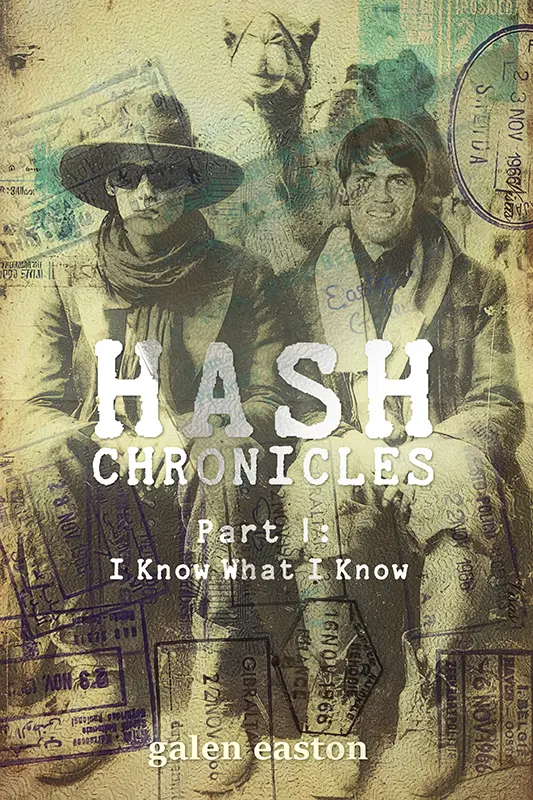
HASH CHRONICLES
The Book
A memoir in two parts.
The 1966 Route — Part I
- JFK
- Iceland
- Scotland
- England
- France
- Spain
- Morocco
- Algeria
- Marseille
- Amsterdam
Part I
I Know What I Know
The ebook launches June 30, 2026. It covers the journey from JFK to Iceland, across to Scotland and England, through France into Spain, across the Strait of Gibraltar to Morocco, and east along the Algerian coast toward Marseille.
Part II
…But I Don't Know What I Don't Know
Part II ebook releases November 17, 2026. Parts I & II together in print October 19, 2026 — launch event at Paragraphs & Pages, Liberty Lake, Washington.
The road doesn't ask where you've been. It only asks where you're going next.
— HASH CHRONICLES, Part I
From the Book
Read the Opening
The foreword and first two chapters of HASH CHRONICLES, Part I.
Foreword
There's no time like the present to try to remember the past, especially when you suspect the past is starting to remember less of you. My life has been filled with moments that come back in flashes, like old Polaroids slowly developing: sharp-edged at first, then gradually blurring at the borders where memory meets invention. Sometimes I can convince myself that these moments really happened, but once convinced, I end up caught in the confusion of a presumption of reality. I've come to understand that memory isn't so much a record as it is a relationship, constantly renegotiated between who we were and who we've become.
This tale that is about to unfold is somewhat true. I'm certain that most of what I am about to say actually happened. Then again, it took place in the mid-1960s. Part of me knows it to be true. At the same time, there's a part of me that wants to draw you into a story that's adventurous and exciting. It seems appropriate to enhance my recollection with a few twists and turns that might steer us a little closer to fiction than strict memory might allow. When that happens, it is intentional. Just as the characters of this story are based on real people, the plot is based on actual occurrences. I'll leave it up to the reader to decide whether they're reading a fictional story based on actual occurrences, or actual occurrences enhanced by fictitious elements.
At this point in my life, I feel fortunate to be here—able to look back on the events with a certain amount of relief that I avoided fucking up my life completely by embarking on what could have become a true nightmare. A moment of wise reflection would have stopped this story in its tracks. But being young, somewhat foolish, and feeling invincible, I made decisions that turned into the adventure of my lifetime. Recently, I came to realize that I had better make a hard copy of these memories before they get completely obscured by the end-of-the-line brain fart. My ominous family history makes this possibility seem more like a certainty.
I know very little about my own father's young life, aside from fragments he'd occasionally let slip during dinner—always the same handful of stories: WWII service (which he always pronounced "Double-ya Double-ya Two"), his time in "Itly" (never "Italy"), and North Africa, learning to drive by commandeering the wheel of a U.S. Army Air Corps truck over an Italian mountain pass while his sergeant slept. And there was that story of his first and last cigarette—lighting up on the overseas transport ship, then spending three days so violently ill he swore off tobacco for his remaining sixty-plus years.
He didn't tell these stories so much as they escaped from him, like small birds suddenly breaking from thick underbrush, startling us with their appearance before disappearing again into his silence. By the time I might have considered a more complete understanding of the man who helped bring me into this story, his memories were buried even deeper inside him than his quiet disposition would allow him to share. I made my peace with having only a cursory understanding of my father, but I want my children to have more of me on which to reflect. At some point I may allow them to ask which of the parts of this tale really occurred and, hopefully, I'll be able to recall which parts those were.
My brother didn't seem to have my memory affliction, although I think he might have referred to his ability to remember more as a curse. He remembered things about our father that I find almost absurd. I'm amazed at his capacity for recall, and when I refer to his part of this story, it's all there, as he remembered it.
The names I use are ours, but the names of any of the other characters are not, as is only fair in a story like this. Names get changed to protect the innocent. And probably the guilty. I have names inscribed in my journal from that four-month period, and I have even been able to contact a few people whose names I wrote down. The one person I would truly like to contact, I fear, may be dead. If he isn't and happens to read this and recognizes the relevant points of the story, I would love to hear more from his perspective. He remains my missing link, which is more fortunate for me as it allows for the flexibility inherent in a tale. If anyone else might read this and recall hearing a similar story from a Dutch fellow who would be in his late seventies or early eighties, that just might be that link. Please contact my publisher.
Chapter 1
The Fast Lane
There are stories you carry for sixty years not because you want to, but because you don't know how to set them down.
My father worked for Kroehler Manufacturing at their Inglewood, California factory—at the time, one of the largest furniture makers in the country. The owner's son had graduated from Culver Military Academy in Indiana but died not long after. In his memory, the family established a scholarship: a full four-year ride to Culver awarded to the child of an employee. The catch was that they gave it only once every four years. I happened to be in eighth grade at just the right moment. You can call it providence, or dumb luck, or whatever you want to call the force that cracks open a door you didn't know existed.
Mom was the one person in our small family to take an interest in my academic progress. Dad was, as was typical in the fifties, the consummate breadwinner. Mom was the one who allowed me the choice of going trick-or-treating on the evening before a sixth-grade writing assignment was due or staying home and completing the assignment. True to my commitment to learning, I made what I knew to be the clear choice.
Through seventh grade, I earned top grades. Sometime during the summer between seventh and eighth grade, my father brought home the scholarship application, handing it to my mother. I quickly completed it, including the obligatory writing sample, and mailed it to the Kroehler home office in Naperville, Illinois. Shortly after the start of eighth grade, I received notice from the principal that he had instructions from the scholarship committee to proctor a series of exams over a weeklong period. I took the exams, enjoying the challenge. Then I resumed my normal school routine, regarding my chances of winning the scholarship as a long-shot.
But one day in early spring, I came home from school to find my mother with tears in her eyes. She handed me a letter. A letter of congratulations. The scholarship was mine. Those ads that appeared in Boy's Life magazine suddenly took on an entirely different perspective. Having just turned fourteen, this furniture worker's kid prepared to ship out to a campus of brick and mortar barracks and frozen Indiana parade grounds where young men were groomed for lives of consequence. Culver had produced generals, senators, captains of industry. The expectation was baked into the stone.
I was invited to visit the campus that spring and I flew alone from Los Angeles International to Chicago's O'Hare International, two of the busiest airports in the country. The attorney for Kroehler met me at O'Hare and took me to his home in Hinsdale to spend the night before driving south to Culver. To say it was a shock to the system is an understatement. Hinsdale was, and still is, one of the more affluent communities in Illinois. But the shock didn't last and I quickly adapted to the culture of wealth, ultimately finding my groove among young men whose parents understood wealth.
I graduated from Culver in May of 1965, in the lower half of my class of just over 200. That fact sat on me heavier than it should have. I didn't yet understand that the yardstick was skewed—that finishing in the lower half at Culver still put you well ahead of most guys your age anywhere else. That recognition would come later, much later. At eighteen, all I knew was that I'd come up short in a place that measured everything.
Meanwhile, our nation's involvement in Vietnam was ratcheting up. The Culver class of '65 walked out of those gates and straight into the teeth of the buildup. A lot of the boys that I'd marched with ended up in uniform for real. Not the dress whites of a Sunday parade but jungle fatigues, headed to the Mekong Delta, Khe Sanh. Some of them didn't come back.
Those four years in a military high school taught me well, and the ROTC instruction from Master Sergeant Torr had left its mark. Standing in front of a classroom of about twenty cadets, he had said, in his southern drawl, the words that are still stuck in my head over sixty years later: "Jelmin, remember the speerit a tha baynet. Keel, keel, keel."
There was no way I was going to participate.
Dr. Wong had been our family physician for as long as I could remember. As his name projected, he was Chinese, with an accent so thick that most of the neighbors found him more trouble than he was worth. They didn't say it unkindly — they simply drifted toward doctors who required less effort to understand. My mother never saw it that way. She worked at understanding him the way she worked at most things that mattered — patiently, without complaint. I remember her coming home from appointments and reconstructing entire conversations for us at the dinner table, animated in a way that made you understand she considered it a small victory each time. He said the most interesting thing today, she would begin, and then proceed to render Dr. Wong's words with a kind of affectionate precision — his cadences, his careful explanations, his genuine concern for each of us by name. The neighbors, she would say, shaking her head slightly, were missing out. A doctor who actually listened was not something you threw away because his r's came out sideways.
It was that same thoroughness — that same refusal to treat a patient as a file to be processed — that now stood between me and a jungle I had no intention of entering. Dr. Wong had not merely signed a prescription pad and sent me on my way. He had thought about it. He knew my history with the duodenal ulcer, diagnosed when I was twelve, and he understood — perhaps better than I did — what the prospect of deployment was doing to my body. The note was not a favor. It was a clinical judgment, rendered by a man who had earned the right to make it.
I needed to find some sort of deferment. My brother Fred's came thanks to a benevolent army evaluator who'd been convinced that Fred was depressed when he went for his physical in March of 1966. We had been called for our military physicals on the same date. My deferment took a little more effort on my part, since our family physician had provided an excuse written on a prescription pad. Dr. Wong had signed it and added in his own handwriting, "Please excuse Galen from military service. He has a recurring duodenal ulcer." I had been diagnosed with the ulcer at age twelve and it recurred shortly after my graduation from high school. The only stressor I could point to for the reason was the looming possibility of being shipped off to a foreign battlefield.
I walked into the Selective Service Center and confidently presented my note to the first official-looking individual I saw. He perused it, gave me a smile that made me cringe, and said, "The line starts over there." When I asked for my prescription back, he tore it in two and said, "Your doctor is going to have to do better than this." Point noted.
I went back the next day and told Dr. Wong what had happened. When I described the official tearing his prescription in two, his reaction was not what I expected. He didn't shrug it off as a predictable outcome or offer a knowing smile at the ways of government. He showed genuine consternation — the quiet, controlled indignation of a man who had spent years earning the right to speak with authority on matters of the body, and who had just been told that authority meant nothing to a man in a uniform. He sat with it for a moment. Then he went to work.
Dr. Wong compiled a full report — my complete medical history from the duodenal ulcer first diagnosed at age twelve, alongside his current findings — and submitted the documentation to the appropriate department at the Selective Service. Within a few months, I received my 1-Y designation. I don't recall the exact date. What I do recall is the relief.
After graduating I went south to Oceanside for my first real job. I was the dishwasher at a restaurant where my older cousin worked as a piano man in the bar. My cousin gave me a bed to sleep in and always had food in the refrigerator. I washed dishes for a couple months and earned enough to get me on track for starting classes at El Camino, a junior college that serviced students in the greater South Bay.
Attending a college preparatory high school did not provide preparation for life's events. It became apparent that I was not ready for the California college system. For one thing, I was designated as an out-of-state student. That meant that not only would I have to pay out-of-state tuition, but my grade point average would be measured differently. My parents couldn't find room in their tiny budget to cover any part of the inflated tuition, and I was woefully shy of the necessary GPA to attend a California four-year state university. That made El Camino Junior College an easy decision. It was close by and everyone lived off campus. El Camino was a two-year program that offered a pathway to the four-year system. Most significantly, tuition was only three dollars a semester.
Nevertheless, Fred and I were both sensing that it was time to consider alternate plans. We had been interacting with other guys our age on the South Bay beaches, all of us following the same general path: getting stoned, going surfing, looking for parties, and working some kind of job to support the lifestyle. College was in the picture, but morning classes were sometimes sidelined by three-foot waves of glass.
I'm not sure why, or when we officially decided to make the move. We were having a pretty damn good time following my graduation from high school. Fred had graduated in 1963 and neither of us knew what we wanted to do. But somewhere in the fall of '66, between surf sessions and those community college classes we'd sometimes attend, an idea began to crystallize: a trip to Europe. We had connections that could help. We just needed to find a way to afford it.
By late summer I was back home and surfing El Porto, working as a cashier for the airport parking company where Fred had started working as a valet, preparing for classes at El Camino College, and learning how to roll a joint. Not enough credits to qualify for a student deferment, but more than enough to keep you occupied when you're also working and surfing and getting stoned. I wanted to do something—I just hadn't figured out what that was yet. A dead man's scholarship had opened the door to Culver. I'd walked through it, and then out the other side into something else entirely.
Fred's LAX job had been the catalyst for my own money-making schemes. Working for the parking lot company, he'd stumbled into what seemed like the easiest money in the world. Rock musicians flying in and out of town would tip him twenty or thirty dollars just to bring their cars around, money that meant nothing to them but felt like a fortune to a twenty-year-old from the beach. Fred would come home with stories about parking Ferraris for actors whose names I recognized from movie marquees. One afternoon, race car driver Carroll Shelby slipped Fred a fifty-dollar bill and told him to "take good care of her" while nodding toward a gleaming Cobra that probably cost more than our parents' house.
"You should see these guys," Fred would say, counting out his tips on his bed. "They throw money around like it's nothing. Yesterday some guitar player I'd never heard of gave me forty bucks just because I knew not to rev the engine on his Jaguar."
Watching my older brother pull down more in tips during a weekend shift than I made in a week was what first got me thinking about faster ways to make money. If Fred could cash in on rich people's casual generosity, maybe there were other opportunities I was missing.
We'd been purchasing single "dime bags"—those carefully measured ounces of marijuana in small plastic bags—from friends of friends for months. But when Danny, a guy Fred knew from his parking lot crew, mentioned he could get us a better deal if we bought in quantity, the arithmetic became irresistible. Why pay retail when we could buy wholesale and make enough profit to fund our European adventure? The transition from buyer to seller was easy.
The plan seemed foolproof to that particular brand of youthful confidence that mistakes luck for wisdom. We'd buy a kilo, break it down into healthy lids, sell them to our close circle of surfer friends, and bank the profits. Same with the acid—buy a sheet, sell individual hits, pocket the difference. Close friends only. No strangers, no risks, just simple business transactions between people we trusted. The business model was a logical extension of any good business model: find something people want and are willing to pay premium prices for, then position yourself as the guy who can provide it.
Fred became our deposit man — it made perfect sense. My job was a ticket taker for the parking company and I made no tips. Fred, on the other hand, had a consistent cashflow from valet tips, making his trips to the bank perfectly natural. That summer, we made three purchases of a kilo each. The routine became almost mundane: drive to the supplier's house, conduct our business, then return home to break down the product in our shared bedroom while our parents watched Ed Sullivan downstairs.
The drug proceeds were coming in slowly, one turnover at a time over three months. While we were still waiting on the final transaction, the parking company was purchased by ATT, and Fred's modest payroll deductions for company stock turned into a windfall of over $500. He sold the stock. We felt we needed more — not out of greed, but out of arithmetic. We had tickets to the East Coast to buy. We felt comfortable with getting to the east coast and visiting family and friends. Beyond that, we had no reliable sense of how long our money would last once we were on the ground in Europe. What we didn't know yet was whether, or not the Selective Service would grant us permission to be out of the country. That was the clock we were running against.
We thought of ourselves as criminal masterminds. In reality, we were more like criminal apprentices stumbling through a game whose rules we only thought we understood.
What we didn't know was that our drug supplier, a guy we knew as "Tree" for reasons that will become clear in a bit, was already under surveillance. The police had been building a case all summer, photographing license plates, documenting patterns, waiting for the right moment to make their move. We'd been seen in the vicinity of Tree's house, though never entering or exiting the front door. If we had known there was any interest in us, we probably would have chosen a different tactic. Years later, in hindsight, it became clear that we had been fortunate in so many ways.
Our plan was simple. We had to quickly gain a reputation for providing measured one-ounce lids without seeds or stems. The '60s in the Southern California drug scene required scrutiny when buying pot. Our marketing motto became "Full Ounce, No Seeds, No Stems." The word spread among our select group of friends and acquaintances that we always had good stuff.
Tree was equally scrupulous about his measurements and quality. Although he didn't spend the time removing stems and seeds as we did, we were always able to measure out a true ounce for each of thirty-two lids and have enough left over for our personal stash. The first lids were gone from our possession within two days, and we were $220 closer to our goal. Then, having reinvested $100 for the next "key," our second and third turn gave us $320 each. With the first kilo purchase and sale, we had the funds for two round trip tickets on Loftleider (Icelandic) Airlines. We only needed the permission to leave.
We felt, with the emphasis on it only being a feeling, that we were insulated from the law. Or maybe it was that looming presence of the draft board. Getting caught for dealing seemed less daunting than putting on a military uniform. We each had our 1-Y deferment and soon sought permission from the Selective Service System to take a trip outside the United States. The application required us to assign a destination. We chose "Western Europe," and gave, as a reason, "Pleasure Tour."
We waited to buy our tickets while the wheels of government slowly ground away. The plan to complete three transactions over a three-month period was in place. If Tree had known this was the extent of our planned dealings, I'm not certain he would have treated us with such deference. He would have preferred a long-term arrangement. In any event, with our strategy in place, we began our summer relationship with our supplier.
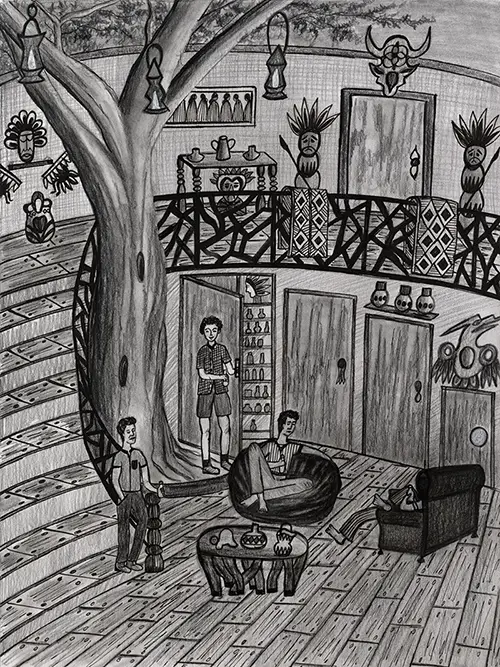
Tree's house sat on a block of lower middle-income homes, its exterior as nondescript as any other tract house from the fifties. But step through that front door, which we did only once, and you entered another dimension entirely—a realm designed by what could only be described as a drug-induced architectural genius. Building codes to Tree were apparently only suggestions that he had chosen to ignore completely.
The most striking feature was partially the source of Tree's nickname: a massive, ancient oak that had been growing in what was originally a sunken courtyard long before Trevor, who had been called Trey as a boy, had inherited the property. "Trey" naturally became "Tree." The oak had been there for decades, its thick trunk and spreading canopy creating a natural centerpiece that Tree had built around rather than remove. The living room floor dropped down a set of wide stairs to the sunken area that wrapped around the oak's base. More stairs spiraled around the trunk to a lower level that served as Tree's main living space. The canopy provided natural shelter from the occasional California rain, while an ingenious system of gutters and downspouts directed water to the root system below.
The lighting throughout the house created constantly shifting patterns—colored bulbs hidden among the branches cast moving shadows across the walls and onto the oak's gnarled bark. Artwork covered every available surface: posters, paintings, tapestries, and sculptures that seemed to emerge organically from the space. The overall effect was disorienting and magical, like stepping into a living kaleidoscope built around this ancient, earthbound giant. There was a chair that was a large soft ball made of old denim fabric. He had stuffed it with ping pong ball sized pieces of styrofoam from old surfboards and a local surfboard shop. The formation of the balls occurred over many months of visitors getting suitably stoned and spending hours listening to music while shaping odd shapes into balls. Several years later I learned that his "invention" had been marketed and was being sold as Bean Bag Chairs.
Most intriguing was a wall lined with four doors of varying sizes—one barely three feet tall, another reaching nearly ten feet, all proportional to standard doors but creating a surreal Alice-in-Wonderland effect. The largest door hid a refrigerated room. When opened, the door revealed built-in shelves of knotty hardwood, smooth to the touch, lined with bottles of beer and exotic fruit juices, each labeled with distinctive hand-drawn artwork.
Two of the doors were never opened in our presence, but the smallest door had a glass doorknob that would glow with an eerie light when someone approached from the inside. During our visit, Tree revealed that it was a secret entrance that connected to the house next door—his grandmother's old place that he'd sold to an airline pilot who had no idea about the hidden corridor Tree had constructed in the basement before the sale. This was to be our entrance and exit to his house. It required some dexterity to get to and from the door with the knob that glowed, but it preserved our anonymity beautifully.
I'm not quite sure how Tree recognized friend versus foe, but the doorknob always turned for us as we entered. The only times we used this entrance was after calling Tree. If he answered, "Hello, this is Trevor," we knew it meant that his neighbor was out of town, flying to who-cared-where. His neighbor had provided him with his monthly flight schedule so that Tree could know when he was away and watch over his home. When I heard "Trevor" my reply was always, "Trevor, surf might be good tomorrow." That would be the message that we'd be over later that evening to score.
The whole setup was Tree's inheritance and masterpiece. His grandmother had left him the house about five years earlier, and his parents had retired to Mexico shortly after that, leaving him free to transform the property into his personal wonderland. The house remained in his parents' name, an arrangement that suited everyone since Tree kept American dollars flowing into their Mexican bank account.
We didn't know that Tree's carefully constructed world would eventually come crashing down, though the timeline would be far more leisurely than either of us could have imagined. Police-work in 1966 didn't move with any greater urgency than our request to the Selective Service to leave the country. But finally that letter arrived. In early September, within days of each other, Fred and I received our SSS Form 300—PERMIT FOR REGISTRANT TO DEPART FROM THE UNITED STATES. Not long ago, almost sixty years later, I was astounded to stumble upon the permit among the few remaining mementos of my adolescent life. My mother had filed it in a binder of our family history.
With the permit, we were now allowed to be out of the country through the end of February 1967. By the end of September 1966, we had our tickets in hand.
Chapter 2
There's Another World Out There
On a crisp October morning, our flight departed Los Angeles bound first for New York. We'd planned a few days visiting relatives and old friends before catching our flight to Europe. We had connections in Brooklyn and I wanted to see the city that had loomed so large in my imagination. New York in '66 was electric with possibility: the Village was thick with music and politics, the museums were free on certain days, and you could eat decent food for a dollar if you knew where to look. We spent three days walking the city until our feet ached, riding the subway to neighborhoods we'd only heard about in songs, and generally feeling like we'd stepped into the center of the cultural universe. Friends took us to a basement club in the Village where Bob Dylan might or might not have played the week before—everyone claimed to have been there, but the stories kept changing with each telling and each drink.
On October 19 at 11 p.m., we caught Icelandic Airlines Flight 001 from JFK to Glasgow via Reykjavik—the cheapest route to Europe, favored by students and backpackers who prioritized adventure over comfort. The plane was a Canadair CL-44 that looked like it had been borrowed from a cargo company, with seats that seemed designed for people significantly shorter than either Fred or me. But it was hard to complain about any possible discomfort. We were on our way to Europe to create an adventure. Little did I know what was in store for me.
I was nimble enough to contort my six-foot one-inch frame into a suitable shape to attempt to go to sleep. But as I closed my eyes, I found myself thinking back on my life growing up in El Segundo. My brother and I had been given the opportunity to live in a place that was nothing like what we'd just experienced in New York City and the people we had met there. My thoughts drifted in and out of segments of my life that had shaped who I'd become. We never regarded growing up in a Southern California beach town during the fifties and early sixties as a big deal. But living in a world of contrasts shaped us in ways we didn't understand then.
The cool, damp marine layer would cling to your skin in the mornings like a second sweater, then burn away by ten o'clock to reveal blazing afternoons where hot concrete could blister bare feet and car door handles became too hot to touch. The omnipresent sound of surf provided a constant white-noise backdrop to our adventures, while salt crystals would form on our skin after beach days, tight and itchy until we showered them away.
We did things that most kids in our neighborhood were doing and we were never at a loss for new adventures that provided an open field of options. This was still the era of crewcuts and before transistor radios, before Kennedy's New Frontier speech had us all looking toward possibility. While other Americans were dreaming of a man orbiting the Earth, we had our Little League Baseball and Cub Scouts. We played sandlot ball until dusk forced us home, curving our baseball caps to the exact right shape, mastering the game of "over the line" and mimicking our Dodger heroes. In scouts, we dutifully learned to tie knots in meetings held in wood-paneled living rooms. These activities provided hazy recollections.
The real adventures of my youth revolved around the sand dunes that loomed behind our house, blocking our view of the Pacific Ocean. One of our friends' dad worked for Sears. This was the source for appliances, which gave us a sporadic supply of cardboard appliance boxes. These boxes became our "tanks" once we removed the flaps and crawled inside.
The base of the sand dunes was a minefield of prickly undergrowth that crackled like breakfast cereal beneath our sneakers and left tiny puncture wounds on our calves when we brushed too close. By midsummer, the relentless heat had baked the moisture from every leaf, transforming the vegetation into brittle sculptures that snapped apart at the slightest touch. The air hung thick with the scent of warming sage and salt, while fine sand particles danced in the heat shimmer, creating an endless supply of tumbleweeds that whispered across the dunes like desert ghosts.
We would hike to the top of the sand dunes to collect the baseball-sized gourds that grew among the succulent icicle plants. With several dozen of these gourds for each of us in makeshift munition pouches, usually made from worn, long-sleeved shirts, we would return to our cardboard tanks and the battle would begin. Crawling on hands and knees inside the box we would try to maneuver to a position where we could fire on the other tanks. We'd plow through the dried tumbleweeds, feeling the plants compress and spring back against the sides of our boxes. There was no choosing sides. It was every man for himself. That didn't mean that two or three couldn't unleash on one.
The sweet smell of crushed sage mixed with the musty odor of old cardboard that had absorbed weeks of our sweat and the metallic tang of the staples that held our war machines together. Inside the box, everything echoed—our breathing, the scrape of our knees against the sandy bottom, the hollow thump when a gourd struck home. The biggest advantage, and disadvantage, of our machinery was the claustrophobic blindness: moving forward meant surrendering to faith and momentum, trusting your body to navigate obstacles you couldn't see, feeling your way through a landscape that existed only in muffled sounds and vibrations transmitted through the cardboard. Your field of vision and ballistic siting was out of each open side. Coupled with the complication of a sack the size of a large baby situated on your chest, the difficulties in maneuvering were not easy to overcome. Sidearm throwers had a distinct advantage in this game.
If you took a gourd to the body on a hard spot, say your head, the gourd would usually acquiesce and spill its contents. Hitting softer tissue felt more like a baseball. Most of the time the gourd pelted the cardboard box and scared the shit out of you. Having no idea which direction the missile came from and knowing that if you turned to throw you'd leave yourself open for a gourd to the body made the game that much more exciting. These battles would go on for hours.
I cannot recall who came up with the next phase of our "war games," but the design and creation of the new weapon was nearly as much fun as using it. We gathered together the necessary materials and climbed to the top of the dunes. Reflecting on the size of those dunes is problematic. We were preadolescents, but I would venture a guess of about 300 feet. Locating records of this piece of geographic trivia has proven fruitless. However tall, they served our purpose. We would bury two eight-foot lengths of two-by-four lumber parallel to each other about four feet apart, and deep into the sand, leaving about three feet sticking out of the sand at a slight angle. A length of rubber cut from the inner tube of a Boeing 707 (thanks to the connection with an American Airlines mechanic a friend's dad had) became the launching mechanism for our giant slingshot. Two or three guys would man their tanks while another two or three would man the grenade launcher. As the tanks maneuvered back and forth across the line of fire like ducks at a shooting gallery, the gourds would be launched toward them. It would take quite a few shots for the grenadiers to find the correct trajectory to even get close to their targets, but eventually, their persistence always paid off.
The gourds were harvested warm from the sun, their smooth shells still radiating heat against our palms as we loaded them onto the rubber sling, which smelled of tire and oil. Each launch produced a deep, resonant twang that vibrated through the wooden frame and up into our arms, followed by the whistle of the gourd cutting through air thick with afternoon heat. We'd track the projectile's arc against the bleached blue sky, then hold our breath during that suspended moment before impact—the distant thud echoing up from the battlefield below, sometimes followed by the sharp crack of cardboard giving way.
We utilized two launching methods. The first involved aiming the gourds to go high into the air which would mean the gourd would be at about 100 feet above the top of the dunes, or 400 feet above the target. Since we were at least eight to ten years away from our first physics classes, the resulting velocity was unmeasurable. One grenadier would count off the seconds from launch to impact. One-one-thousand, two-one-thousand, three-one-thousand, etc. The second grenadier would count the seconds for the target to traverse the territory and reach the impact zone. The angle of the launch would determine which of the three tanks would be the target. The second method was to try to aim straight down the dune. This sent the gourd flying so fast that if it hit the tank, it would sometimes rip a hole through the cardboard, which, fortunately, would slow the gourd enough to not cause harm to the operator.
A turning point in our pre-pubescent search for excitement occurred with an introduction of my best friend's older brother Terry to our war games. Not that he seemed that interested in what we were doing. The excitement came from the opportunity for him to show us what he was capable of doing. Our "killing fields" took on a potential fresh meaning when Southern California Edison began erecting a series of high-tension power lines at the base of the sand dunes. The construction had started during the winter while we were still busy with school. As summer approached, the oversized Erector Set towers were completed, providing the perfect outlet for a teenage testosterone-saturated adolescent like Terry to show his daring prowess to us lesser humans. Our only requirement was to provide him with a boost up to the lower section of the metal structure. And then watch in awe as he scaled the behemoth.
"Impressed" would not adequately express our feelings as we stood below with the back of our heads married to our spines. Without missing a beat, Terry climbed thirty feet to the first arm protruding from the tapering tower. Nimbly rising from his knees to his feet was impressive enough, but he adeptly transformed himself from best friend's older brother to near god status by casually walking to the end of the arm. Looking down at us, he yelled, "You should see the view from here! Come on up. If you can handle it!" We looked at one another, instantly determining that none of us were that crazy.
Terry made a quick turn around and headed back to the tower. But instead of beginning his descent, he began climbing to the second arm. In less than a minute he was repeating his earlier feat at the end of the second-level arm, now about fifty feet off the ground. Watching Terry scale that electrical tower was pure terror disguised as admiration. We could hear the metal creaking under his weight, sense the vibration in the ground beneath our feet as he climbed ever higher. The smell of hot metal and ozone seemed to intensify with each level he reached, while our necks ached from craning upward against the white-hot sun.
We continued watching what was now a clear sign to us of pure insanity. Slowly lowering himself so that his legs could straddle the horizontal metallic structure, Terry somehow ended up with both hands holding the metal while the rest of his body dangled fifty feet above us. He showed no fear, as we commented to each other about what was most certainly going to be the last time our friend would see his older brother alive.
Two hands holding on was insane, but when he let go with one hand, we knew the end was near. The silence was near absolute—even the sound of the ever-present surf seemed to pause in anticipation. All we heard was Terry whooping and hollering. He was actually enjoying this! Then he reattached his second hand to the structure and began moving back toward the center and, with arm strength that we could only imagine having, he reached the main tower and climbed back down.
Later that summer, when we first saw the spools of power cables placed beneath the towers, our first thought was that our shenanigans were over. Apparently, SCE understood how important these activities were for boys. They graciously stopped installation of the cables after attaching several lines to the appropriate arms of the towers but left the lines stretched from the lower arm of one of the towers to the spool on the ground. The distance from one tower to the next was about 500 feet, which meant that the cable approached the ground after about 400 feet. We finally had an excellent reason for climbing the tower to at least the lowest arm. Using a variety of leather straps, including belts, we would climb to the arm, find a way out to the cable attachment by whatever means felt the safest, wrap the leather around the cable and launch off the metal arm. The ride down was short—nine or ten seconds—but exhilarating, dropping forty feet over a 300-foot span. With two or three seconds of the ride left, you had to start running in the air so that when your feet hit the ground, you could slow your momentum before running into the spool.
Looking back on it all now, I would have to say we were having a pretty fucking awesome time growing up. We didn't realize it then—how could we?—but those afternoons on the dunes were shaping something essential in us: comfort with risk and a hunger for freedom that would later drive our more consequential adventures. The sand burns on our elbows and the bruises from poorly aimed gourds were badges of an education no school could provide.
By the time we hit junior high around '59, we were seeking other adventures. This was the dawn of Kennedy's America, when the future seemed limitless and danger was something that happened to other people. The opposite sex was starting to appear on the radar, but we became easily distracted from that. Living close to the beach, but not lucky enough to be within walking distance as some of our friends at school, we found other ways to create excitement. We hauled ass down Palm Avenue, one of the longer and steeper streets in our neighborhood, on our Flexies, oftentimes weaving in and out of driveways and back into the street, avoiding the occasional car as we took our turn.
The Flexy Racer wheeled sled was a favorite item found under the Christmas tree in the mid to late fifties. We didn't know the word "adrenaline" at that point in our lives, but we knew that the Flexy sure beat the hell out of bicycling. The bike was sufficient for transportation to school or to the Little League field. The Flexy was our first venture into mind-altering experiences. Speed was our goal. Then we started surfing, another mind-altering experience. The Flexy became our dry-land practice board.
But for the types of turns we were attempting, the Flexy was too big and not responsive enough. So, one of our friend's dad had a shop in his garage and we got him to cut some pieces of plywood scraps. The metal, clip-on skates we got for Christmas a few years back, gathering dust in the garage, had the kind of wheels that would allow us to slalom down the local hilly streets. We separated the front of the skate from the back and screwed the skate wheels onto the bottom of the plywood.
Our first skateboards were problematic. The transition from Flexy to skateboard was visceral—trading the smooth, controlled slide of the sled for the harsh vibration of metal wheels on concrete that rattled up through your bones. The smell of rubber and metal from those clip-on skates mixed with the hot asphalt as we carved turns that left streak marks and sent sparks flying when the metal wheels caught the wrong angle. Balance became everything—that moment of weightlessness before a turn, the flutter of panic in your stomach when you felt control slipping away.
The metal wheels would not grip the concrete pavement, and the friction that was created by the metal against the sidewalk made the softer, smoother asphalt of the street much more appealing. We removed the rubber cushions, which allowed for more radical turns while keeping all four wheels on the surface. Prior to discovering this, we would attempt pivot turns by putting more weight on the back foot and lifting the front wheels as we cranked a turn. With the cushions removed, we could turn to the left and right with all four wheels touching the surface. This action would more closely resemble the moves we practiced for surfing.
Surfing.
I had played in a variety of organized or team sports from childhood Little League to beach volleyball. But surfing for me was a non-competitive sport, something I did just for the beauty of doing it. With my high school years spent at the college preparatory military academy in the middle of the cornfields and hog farms of Indiana, I had only my summers on the South Bay beaches to surf. My brother, on the other hand, had all year to hone his surfing skills. He'd also graduated from high school two years ahead of me and had even more time to embrace the sport. I would never reach the level at which he was able to excel.
My years in high school sports included the ubiquitous Indiana activity of basketball. I played well enough to make the JV team as a freshman solely due to my height. By the time I was a sophomore, I was knocked out of the running by the shorter kids from Indiana who had finally hit their growth spurts over the summer, and who'd been playing in summer leagues at home while I surfed back in California.
I played football, baseball, tennis, and golf. I rowed crew in an eight-man skull. I wrestled in a weight class where my only advantage was the leverage I could create with my long arms and legs against kids my weight but four to six inches shorter. But my muscles could not match theirs, leaving my "pretzel move" inadequate against their speed and strength. Surfing, in contrast to these competitive sports, was just something that made you feel good.
But for now, I'd put surfing on hold. There was a new adventure unfolding in front me. Somewhere over the North Atlantic, pulling me from my reflective reverie, the captain announced that our connecting flight from Reykjavik to Glasgow had been overbooked. Would any passengers be willing to accept a two-night stay in Iceland, all expenses paid, in exchange for taking the next available flight in three days? Fred and I looked at each other with the kind of grin that probably worried the other passengers. Free hotel, free meals, and an unexpected adventure in a country neither of us could have found on a map the week before? We were practically fighting each other to get to the flight attendant first.
Foreword & Chapters 1–2 · HASH CHRONICLES, Part I
A Soundtrack
1966: Best of Rock
The sound of the year galen easton hit the road. Press play and let it run while you read.
Open in SpotifyCartography
The Road
Three legs, drawn from the journal — north across the Atlantic, the crossing at the Strait, and the long way home.
Leg One · Iceland to Algeciras
JFK to Iceland, down through Scotland, England, and France into Spain — ending at Algeciras.
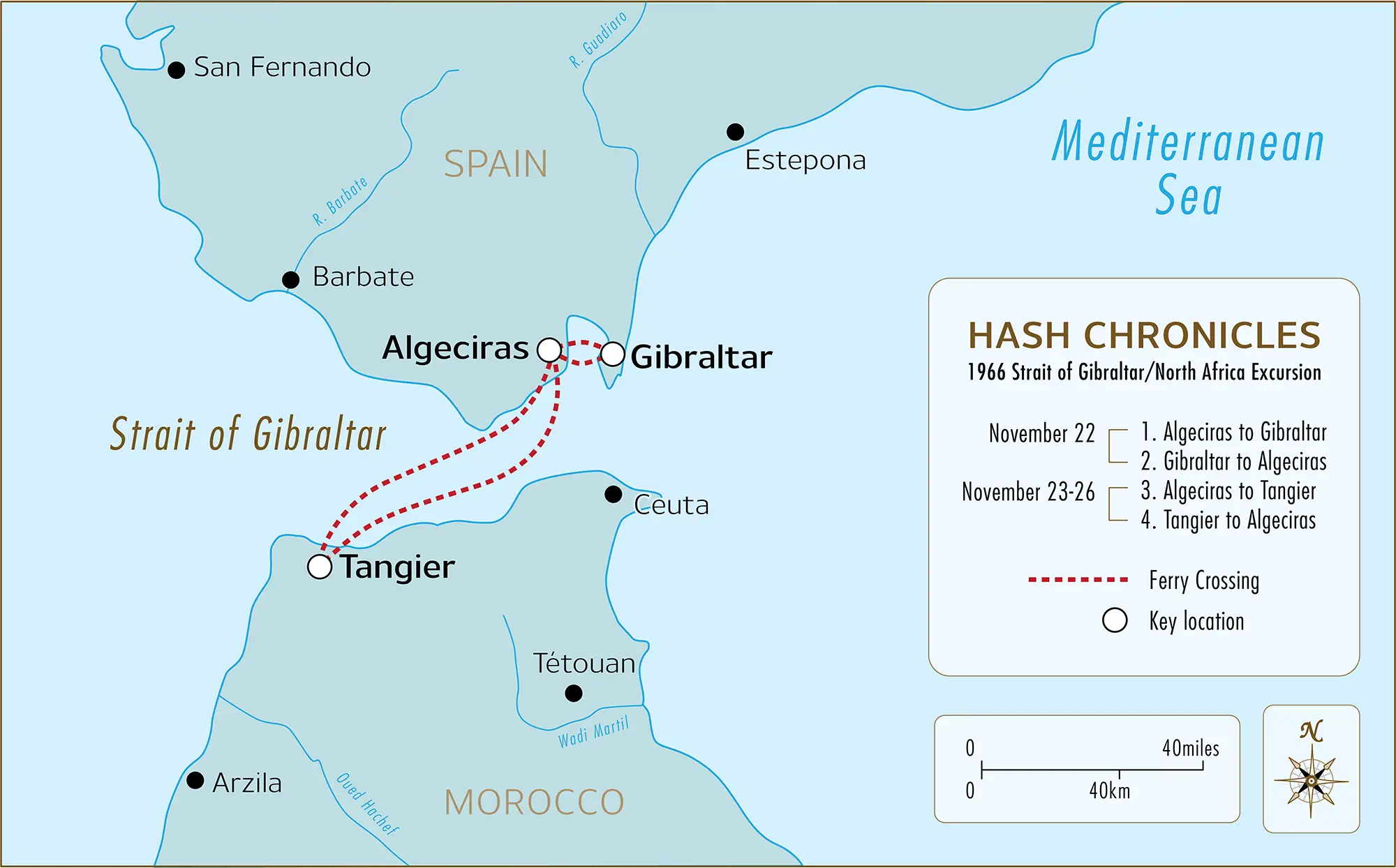
The Strait · Gibraltar & North Africa
The ferry crossings — Algeciras, Gibraltar, and over to Tangier. November 22–26, 1966.
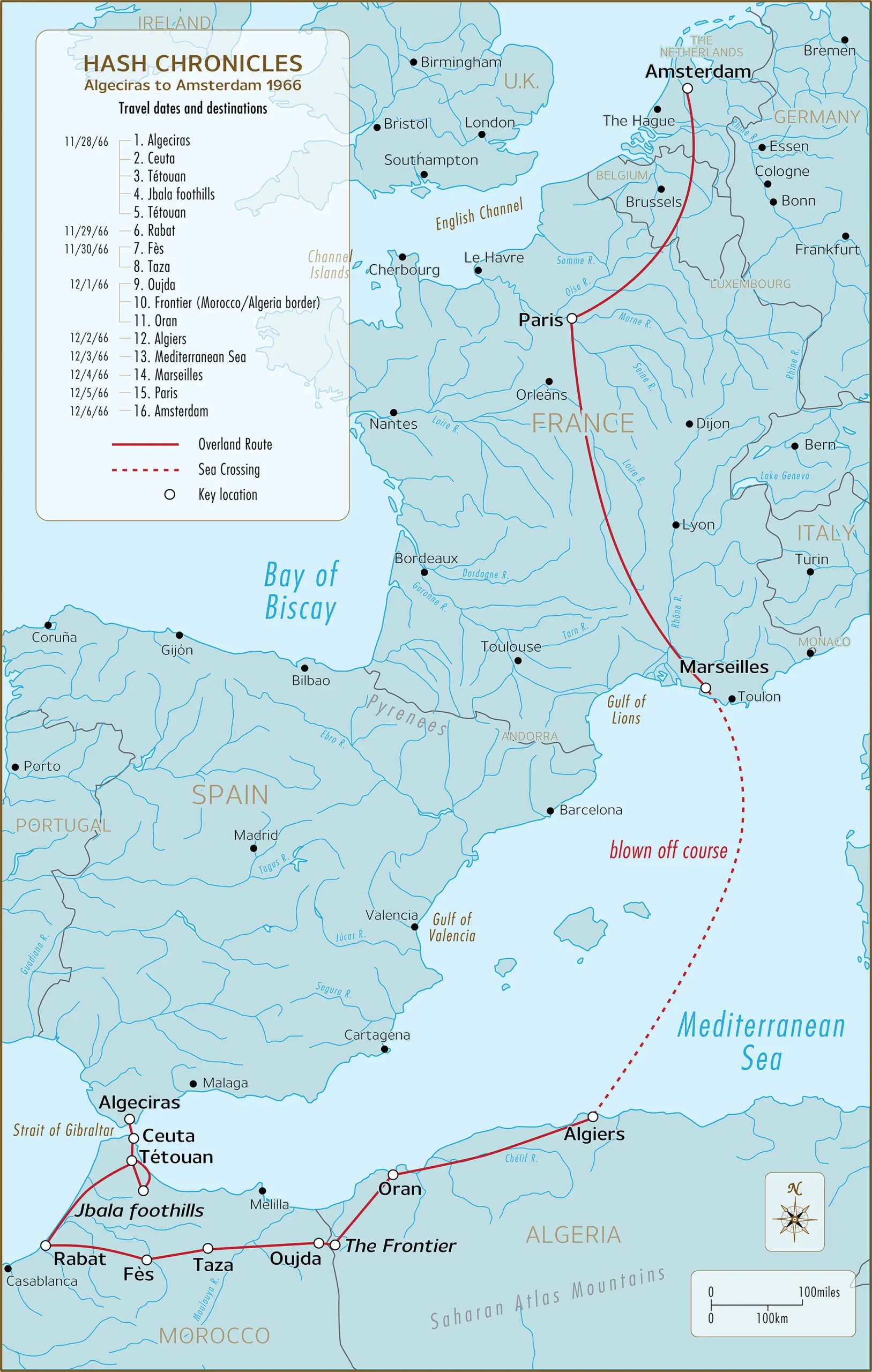
Leg Two · Algeciras to Amsterdam
Overland through Morocco and Algeria, the sea crossing to Marseille, then north to Amsterdam. November 28 – December 6, 1966.
Route maps by Tracey Porter · Pixeleiderdown
From the Road
The Papers
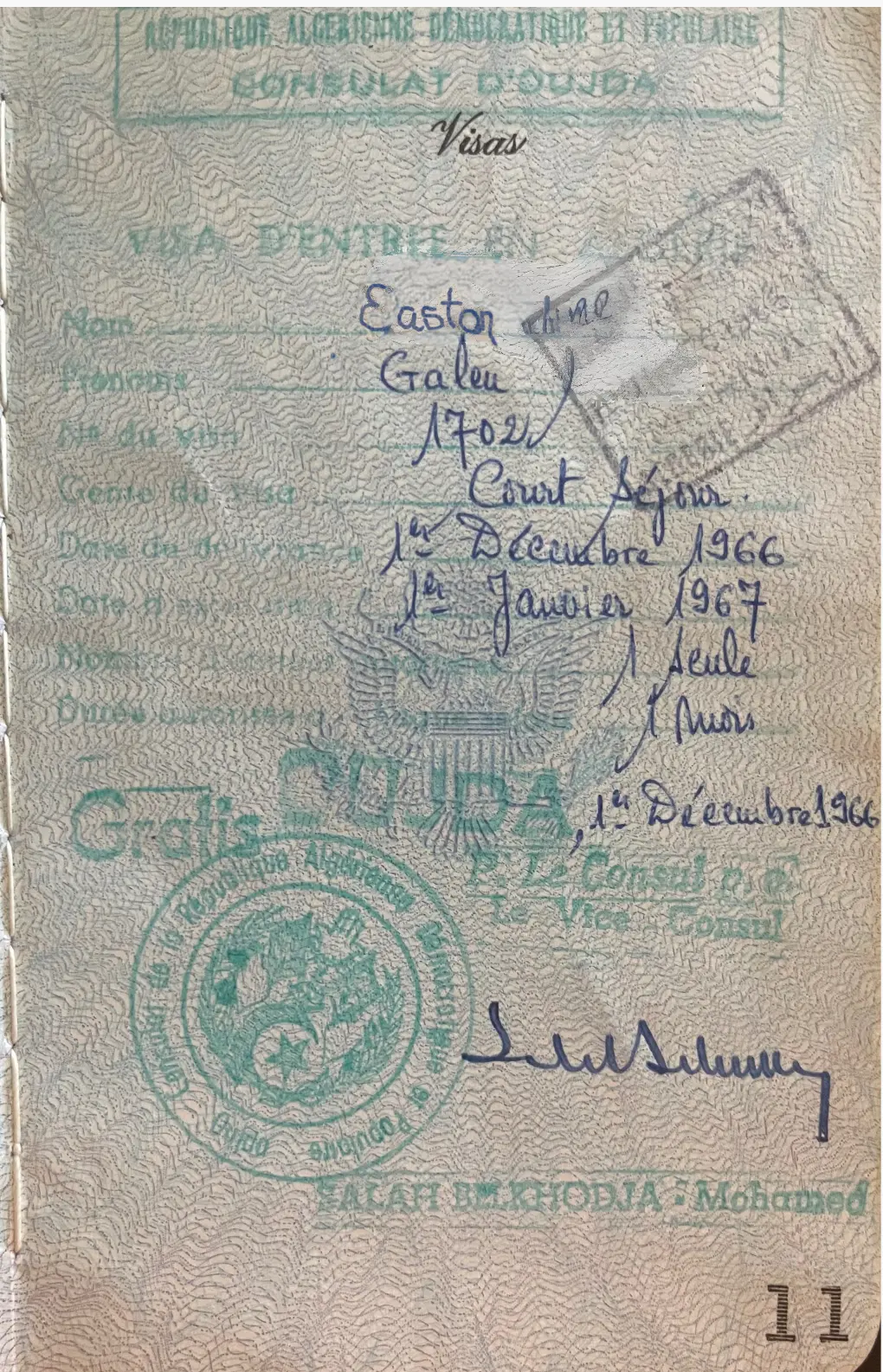
Algerian visa, 1966.
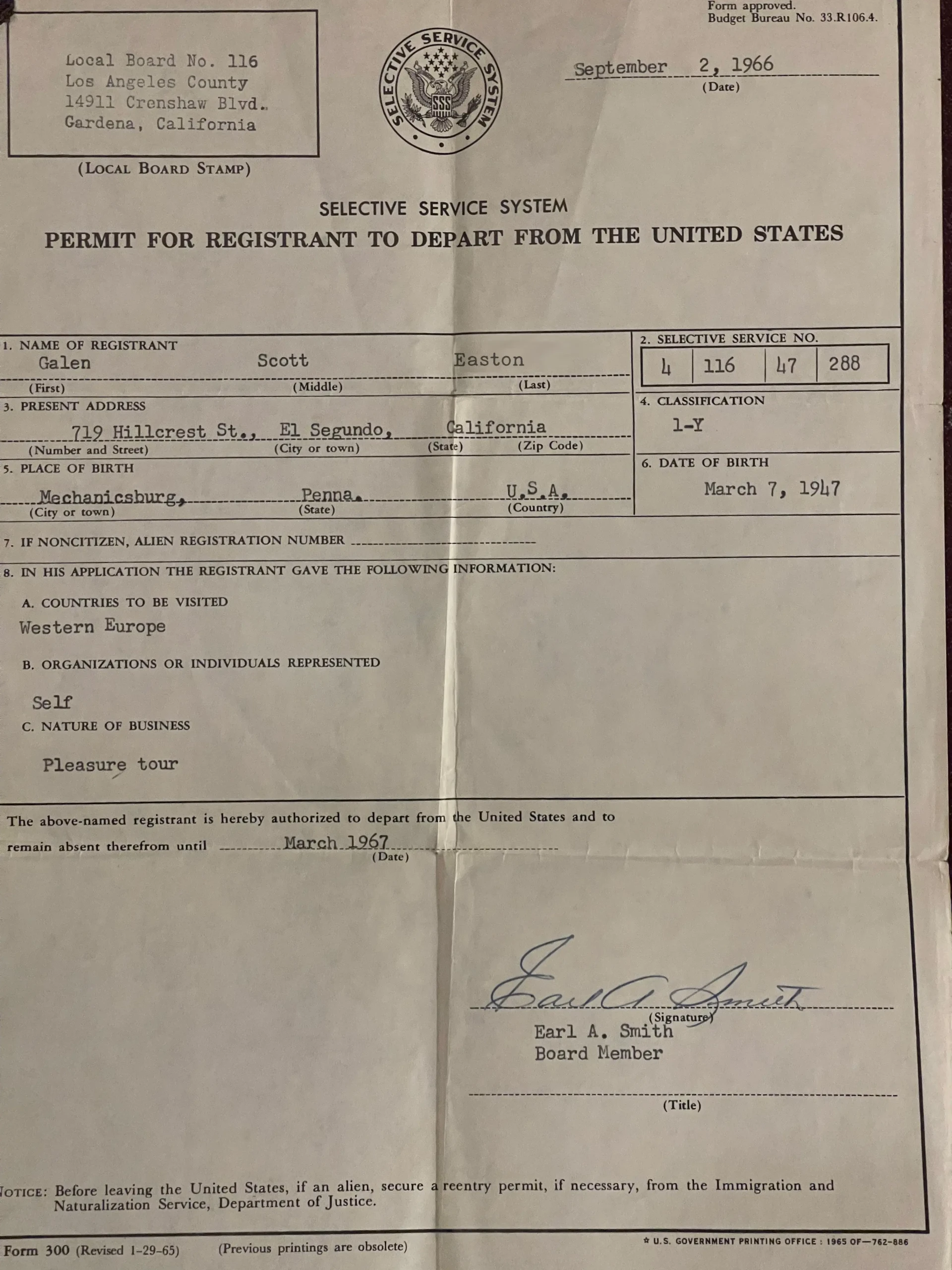
Travel papers.
Cover art created by SusansArt@99designs for Inlet Press LLC